欢迎您,您是第
179408 位访客
EN英文版


中心成员殷逢俊提出一种水质亚硝酸盐电化学检测新方法
发表时间:2025-05-19
中心成员殷逢俊提出一种水质亚硝酸盐电化学检测新方法
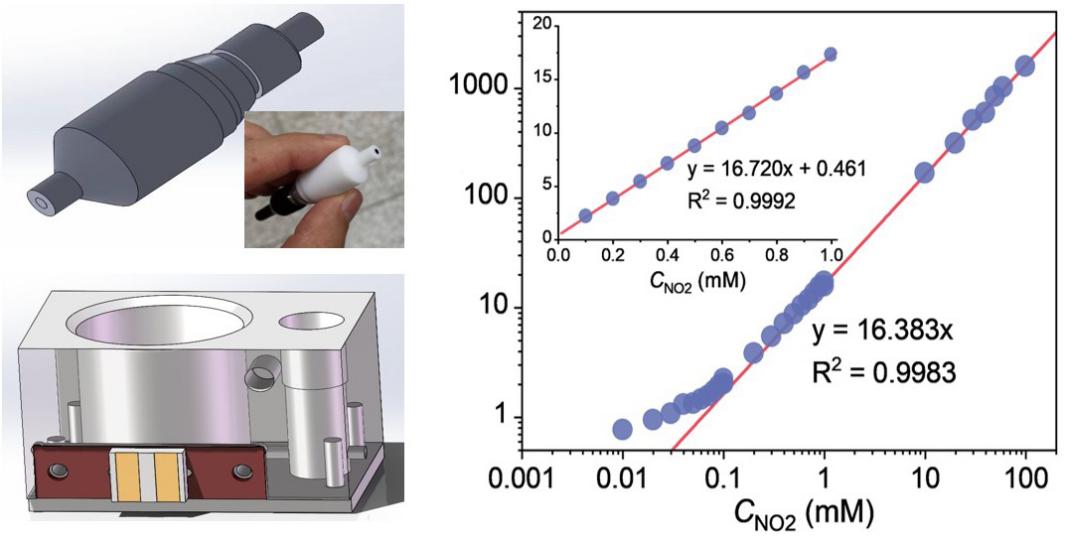
中心副研究员殷逢俊在Water Research上发表学术论文 “Electrochemical nitrite sensing using mass transfer signal with a catalyst-free small-sized rotating disk electrode for wastewater monitoring”。作者通过获取亚硝酸盐氧化的传质控制信号,提出了一种水质亚硝酸电化学传感检测方法,这种信号检测的准确度只取决于电极界面传质过程而与反应动力学无关。为此,研制了一种无催化剂的小尺寸玻碳盘旋转电极,直接用于亚硝酸盐检测电极,检测样品量小于4 mL,具有出色耐用性。本方法线性检测范围为100 μM~100 mM,检测限为28 μM,灵敏度为1638 μA mM-1 cm-2,溶液pH和缓冲物质不干扰检测,对惰性离子、COD、金属离子、溶解氧、过氧化氢等具有较强抗干扰能力,但会受到还原性物质的氧化反应影响。最终验证了本方法对化粪池污水、污水厂进水、工艺出水检测的可靠性。
https://doi.org/10.1016/j.watres.2025.123346
Fengjun Yin proposed a new method for electrochemical nitrite sensing in wastewater monitoring
Fengjun Yin published a paper titled "Electrochemical nitrite sensing using mass transfer signal with a catalytic-free small-sized rotating disk electrode for wastewater monitoring" in Water Research. We developed a novel electrochemical nitrite sensing (ENS) method that utilizes the mass transfer signal (MTS) of the nitrite oxidation, making detection accuracy dependent solely on mass transfer process. These features enabled us to design a catalyst-free, small-sized glassy carbon rotating disk electrode for accurate MTS determination with exceptional durability. The method requires a sample volume of less than 4 mL and exhibits a wide linear detection range of 100 μM to 100 mM, with a detection limit of 28 μM and a high sensitivity of 1638 μA mM⁻¹ cm⁻². Notably, the detection performance remains unaffected by variations in solution pH and the presence of buffer substances. The method demonstrates strong resistance to interference from inert ions, chemical oxygen demand (COD), metal ions, dissolved oxygen, and hydrogen peroxide. However, it can be influenced by the oxidation of reducing substances. Finally, the study validates the reliability of this approach through detecting nitrite concentrations in septic tank wastewater, WWTP influent, and process effluent samples.
